latest blog
दिल्ली की कहानी, देहात की ज़ुबानी
Delhi 360: Urban Dehat invites students, researchers, artists, and storytellers to contribute to our blog—an open platform to reflect on the rich and layered life of Delhi’s (urban) villages. We welcome short articles, maps, commentaries, photo essays, book reviews, graphic articles, comics, and other creative formats that explore themes such as everyday life, history, culture, memory, caste, gender, heritage, archeology, ecology, politics and spatial transformations.
Your write-up should be of 1000 words only with a maximum of 5 images.
Minimum 05 references.
Email your write-up to delhiurbandehat@gmail.com
Editor: Dr. Shekhar Tokas
The Hand at the Threshold
Dev Uthani Gyaras, Silakheri’s Rock Art, and the Long Memory of the Aravallis in NCR
Shalaish Baisla , PhD Scholar SHRM, Dr. B.R. Ambedkar University Delhi
(Published June 29, 2026)
On the eleventh day of the bright fortnight of Kartik, households in all of Delhi’s urban villages celebrate Dev Uthani Gyaras, the Festival of Gods Awakening from a four-month monsoon sleep. The women of the Ahir, Gujjar, and Jat families create the images of Devas (gods) and Mora (peacock), with lime or ochre paints, on both sides of the door and on the threshold. They will also create footprint images for everyone in the home: people, animals, kids, and even dogs. It is not called Archaeology by anyone. However, I believe it uses some of the same reasoning as one of the earliest forms of marking making in India, and the nearest examples are not in far-off Rajasthan but rather at Silakheri in Faridabad, which is the nearest known Rock Painting Site to Delhi.
The Referential Frame
Vineet Godhal’s study of the archaeology of Alwar District, “Heritage: A Journal of Multidisciplinary Studies in Archaeology,” Vol. 8.1, 2020, documents over 200 rock shelters at the Dadikar-Hajipur site within Sariska, fifty-two of those being painted in red (hematite). As such, the paintings themselves deserve attention. Most common are rectangular enclosures representing homes for the gods that protect children and floral forms. Swastika symbols appear on some of the paintings. In addition, there is one image of a hump-backed bull with a visible dewlap drawn in detail. Images of both males and females along with their children have been depicted as part of the same family. Godhal also noted that many of the images used today in various festivals and rituals have remained the same since they were originally created. Therefore, this body of work can be viewed not just as a representation of the past but as a contemporary expression regarding the present. When compared to other forms of expression associated with the festival, it also represents a continued practice relative to the fundamental nature of ritual: the framed space; the family unit (and/or the family unit including domesticated animals); and a readily obtainable natural pigment applied during a time when seasonal activity reaches a peak. While the materials used have transitioned from Hematite to Lime plaster, and the surfaces where the artwork was applied have changed from cliffsides to doorsteps, the grammatical structure has remained consistent.
Silakheri: The Closest Rock Paintings to Delhi
Silakheri village, located in Faridabad, has never received the recognition it should. Located at the tip of the Aravali spur that extends into the NCR, it houses some of the most historically significant rock art to be found nearest to Delhi. This will shift our focus from far-off Rajasthan to this landscape and community. In early 2026, while conducting a heritage walk in Silakheri, I recorded red ochre rock painting on the local outcropping; the compositions are similar to those of the Dadikar-Hajipur panels: bovines, schematically depicted humans, enclosed rectangular-shaped compositions, all created with a hematite of the same character. Not only does the Aravali line pass through Alwar, the Mewat hills and the Faridabad outcrops geologically but also culturally; i.e., it is a path along which herding communities have been moving and creating images for thousands of years. Silakheri is one such location and so are many of the urban villages surrounding Delhi.
What the Festival Keeps
Painted on stone, the Deva-Mora carries all the things that come back to you when viewing the rock art. First, there’s a census in paint; the footprints of every human being and animal surrounding the deity serve as both an accounting (counting) and a protection simultaneously. Second, earth pigments were used to mark thresholds at specific times during the ritual year. Third, we see cattle – the hump-backed bull depicted on the shelter wall, the footprints next to those of humans at the doorway, the herd as part of the family unit.
I want to be careful here. The women painting their doorsteps are not copying older art, and the continuity I describe is not one of conscious memory. What survives is structure rather than recollection: a set of conventions, a choice of material, a bond between the turning season and the marking of a household’s living members. The Ahir and Yadav cattle-keepers, the Gujjar herders, and the Jat cultivators who keep this festival belong to the same agro-pastoral world whose people once painted in the Aravallis. Silakheri places that world inside the very district that holds Delhi’s edge villages. Its rock art is still unpublished and unsurveyed. It should not remain so.
That is to say that, in the most profound sense possible, the Deva and Mora at your doorstep and the red ochre figures on the Aravalli rocks were made by one hand; that of agricultural/pastoralist communities for whom marking the household’s living world at the turn of each season is equally a spiritual act and an account. There are many similarities. Unfortunately, we’ve never viewed it this way.
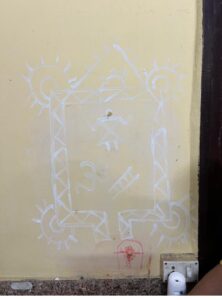
Plate 1. Dev Uthani Gyaras painting on the exterior wall of a household in Delhi’s urban village.
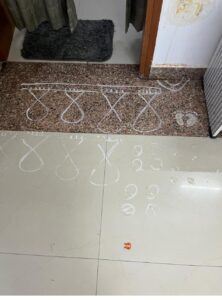
Plate 2. Threshold painting showing cattle and human footprint census in lime on granite threshold stone and tiled floor.
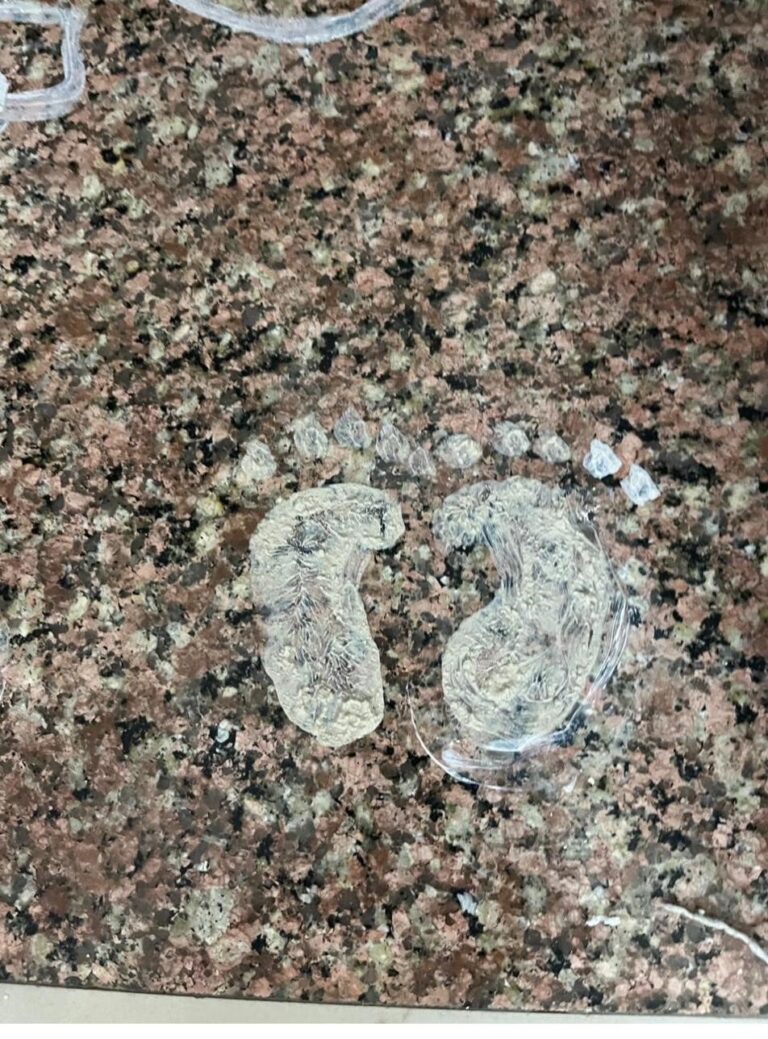
Plate 3. Detail: paired footprints on the threshold stone.
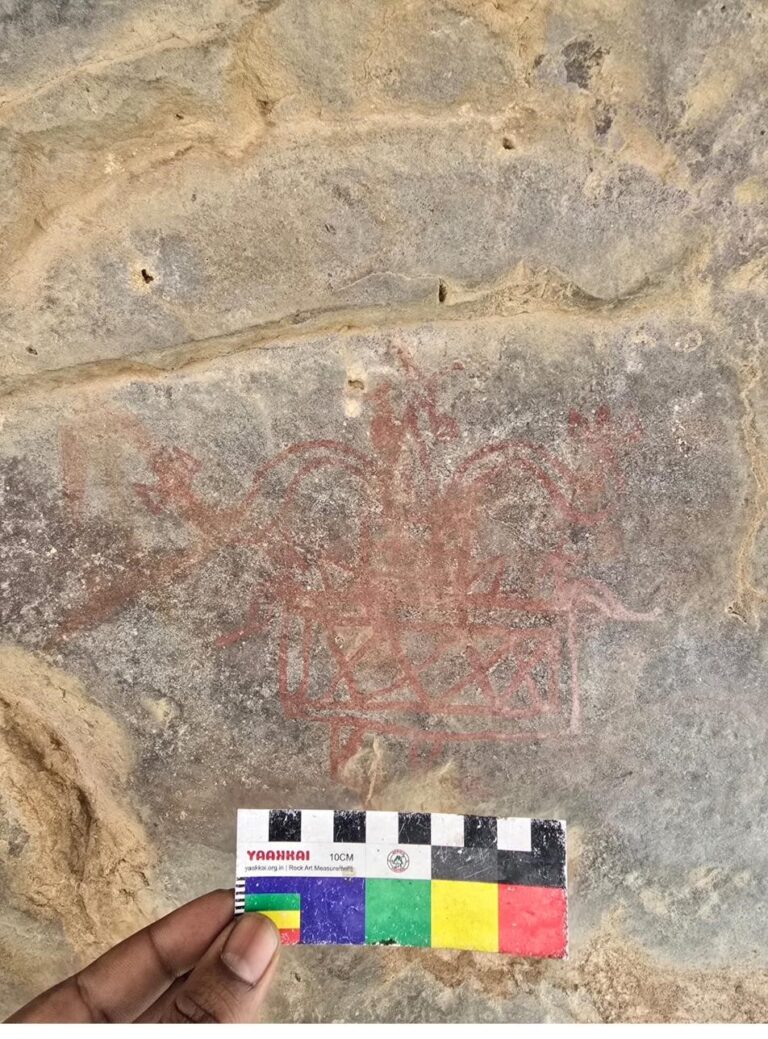
Plate 4. Rock painting panel, Silakheri village, Faridabad district, Haryana. Silakheri represents the closest documented rock painting site to Delhi within the NCR’s Aravalli extension.
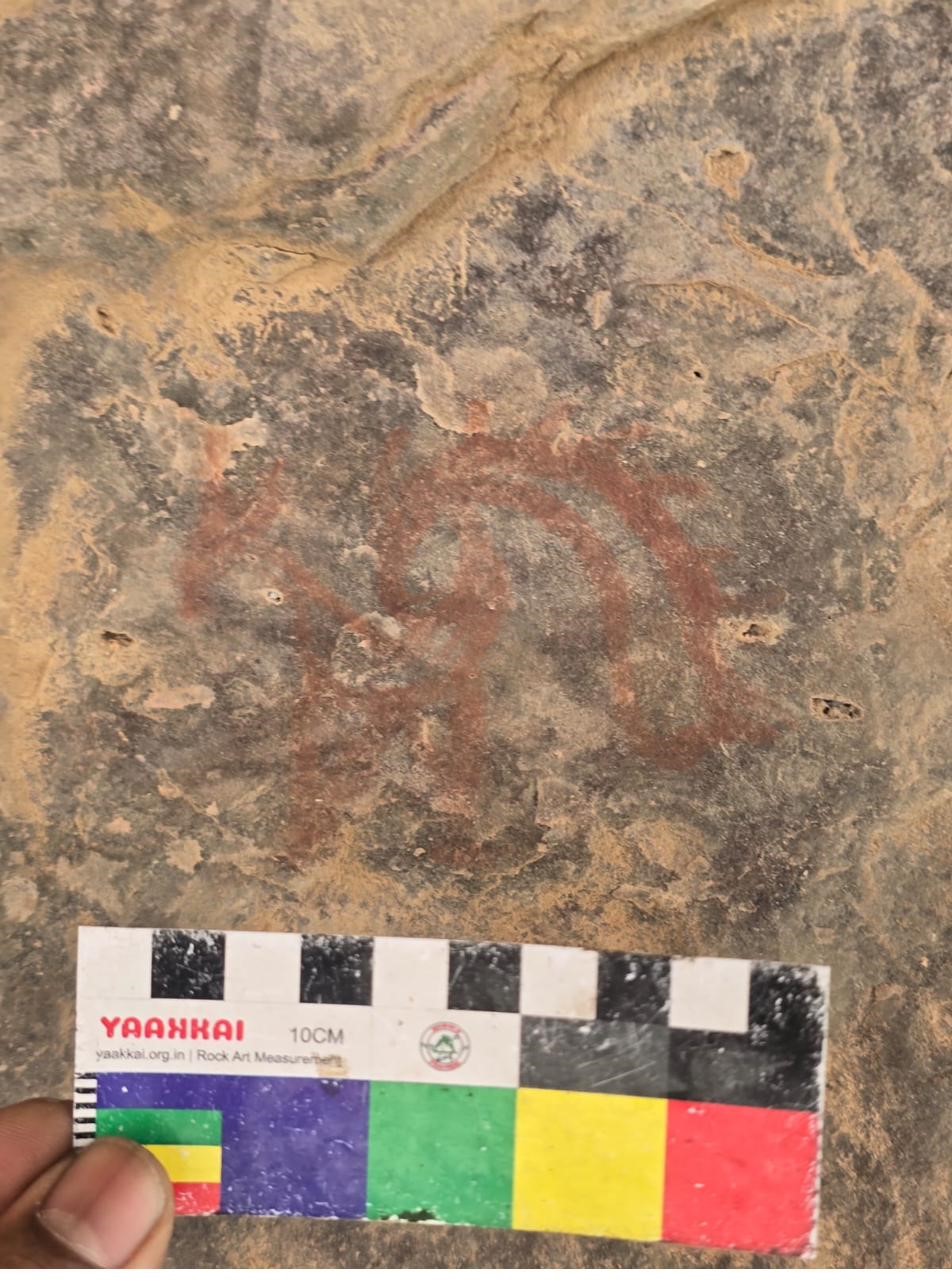
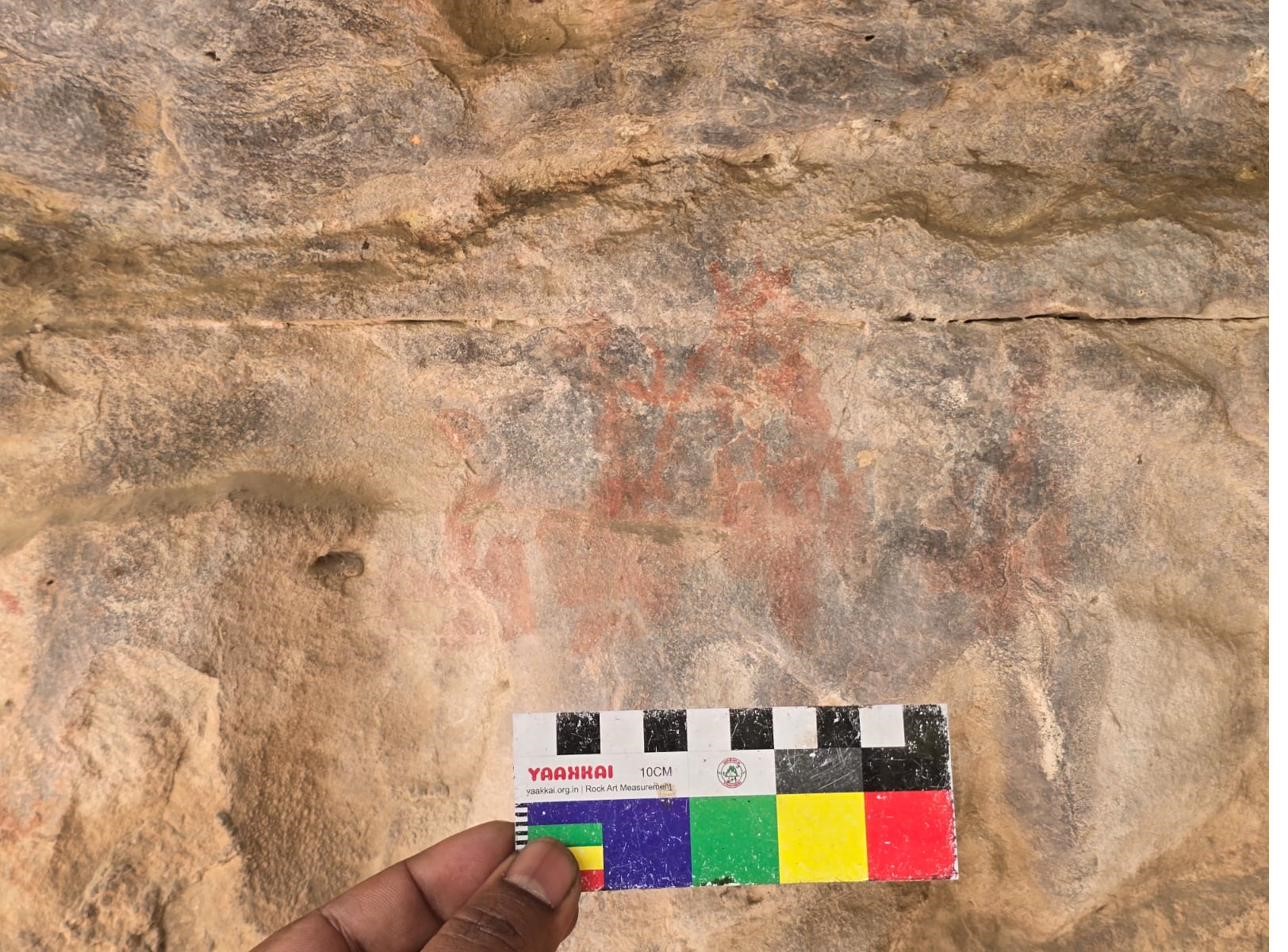
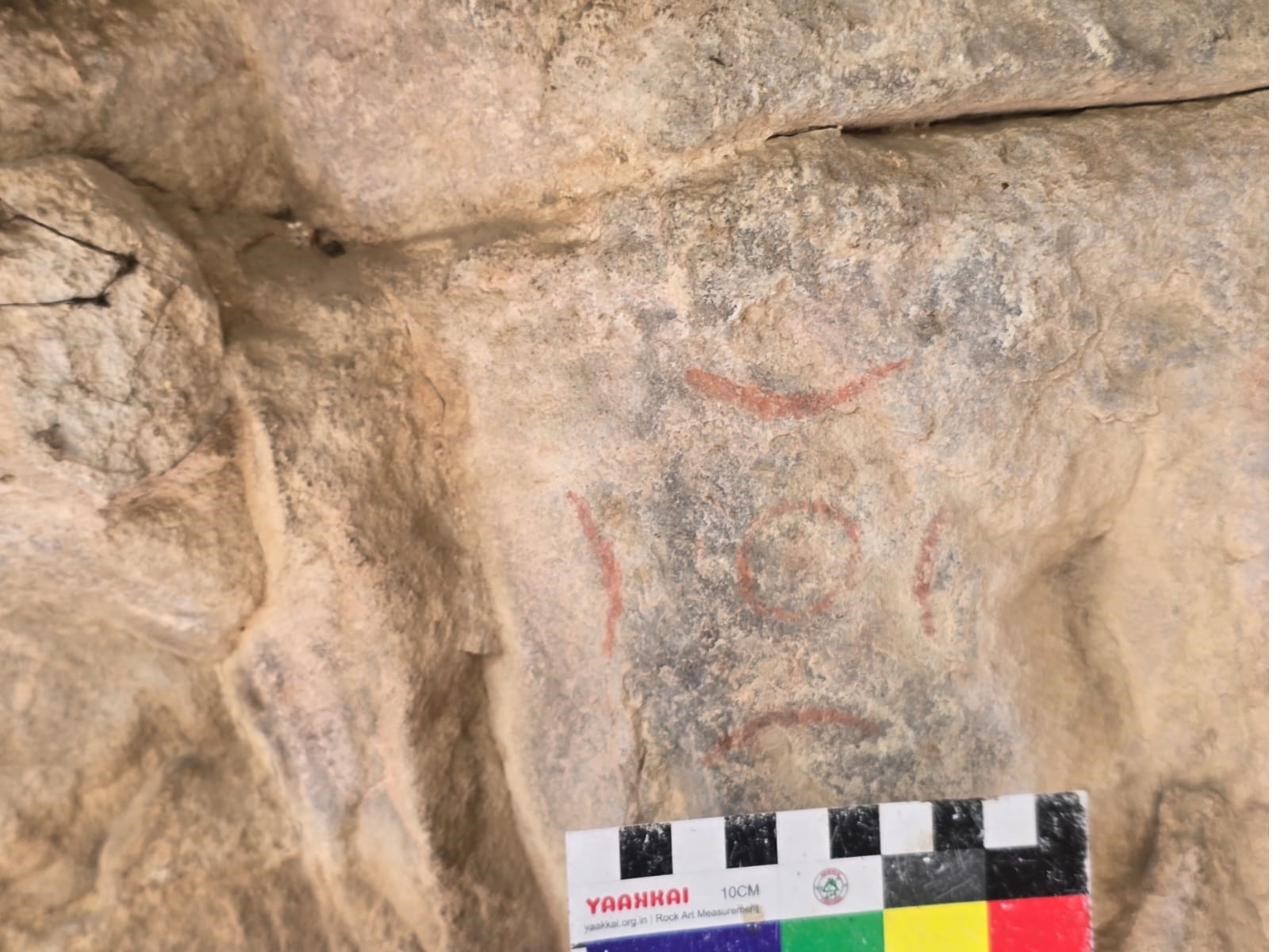
Plate 5. Mora (Peacock) motif in red ochre, Silakheri. Scale: 10 cm.
Plate 6. Animal figures in red ochre, Silakheri. The compositional relationship between bovine motifs and human/group figures visible here parallels the structure of the Dadikar–Hajipur paintings and the contemporary Dev Uthani mark-making tradition.
Plate 7. Detail of schematic anthropomorphic and zoomorphic motifs, Silakheri. The ochre pigment and confident line-work are consistent with the hematite-based historical rock art tradition documented across the Sahibi Valley and Alwar region of north-east Rajasthan.
One City, Many Names: Indraprastha, Yoginīpura, Dhillikā, & the Evolution of Delhi
Ankit Chanchal, PhD Scholar in Heritage Studies, Dr. B.R. Ambedkar University Delhi (Published June 26, 2026)
Delhi was a memory before it was designated a capital. It was a story before it became a memory. Poets, pilgrims, emperors, and chroniclers referred to it by several names over the ages, such as Indraprastha, Yoginīpura, Dhillikā, and Dhillī, each of which revealed a distinct city, scenery, and history. Tracing these names is analogous to comprehending Delhi’s history reconstruction. Delhi’s history is often recounted through dynasties, monuments, and successive capitals. However, an investigation of the city’s names might also provide insight into its evolution. These toponyms are more than just geographical markers; they retain cultural traditions, political authority, sacred landscapes, and social identities. Considering these names indicates that early Delhi was neither a single city nor an unambiguous urban centre. Instead, it was a complicated terrain full of towns, sacred spaces, political strongholds, and landmarks that were remembered. Different literary traditions adopted various monikers to characterize this terrain, frequently reflecting their own partisan objectives and cultural concerns. As a consequence, the development of urban identity in early northern India is inextricably linked to the history of Delhi’s nomenclature.
Indraprastha has the strongest cultural resonance of all the names pertaining to Delhi. Its beginnings can be traced in the Mahābhārata, where it is mentioned as the capital founded by the Pāṇḍavas following Khaṇḍavaprastha’s metamorphosis. The city is presented as a magnificent royal centre that represents lawful monarchy and political stability. However, for historians, the question of whether or not a real city is mentioned in the Mahabharata should not be the primary concern; rather, it is more important to consider how later societies embraced the tradition of this epic. The connection between the Delhi region and Indraprastha was well-established by the early medieval period. The epic name firmly placed the region in the subcontinent’s sacred geography and attributed it to one of the most cherished narratives in the Sanskrit Corpus.
Along with references to the epic tradition, the Puranic literature has descriptions of Indraprastha. Most notably, Indraprastha is mentioned as a Tritha (pilgrimage) site in the Vishnu Purāṇa, the Padma Purāṇa, and the Bhāgavata Purāṇa. We also find descriptions of Indraprastha in Jātaka literature, particularly Kurudhamma Jātaka, Kāmantīta Jātaka, Sambhava Jātaka, and Dhanañjaya Jātaka, along with the Cariyāpiṭaka, the Buddhavaṃsa, and the Raṭṭhapāla Sutta from the Majjhima Nikāya. Indraprastha as Inrdapatta.
By the beginning of the early medieval and later in the medieval period, references to Indraprastha transcend to the realm of literary imagination and emerged with the established epigraphic record, attesting to toponyms’ enduring historical and cultural significance. This Indraprastha represented a territory descriptor and a cultural assertion. It connected native geography to broader traditions of religious and political legitimacy and turned the landscape into a site of remembered antiquity. Following a long hiatus after Purāṇic traditions, two pertinent toponyms in literary, epigraphic, and historical traditions were employed to denote the region that corresponds to modern-day Delhi during the early medieval period. The first was Delhi, which became the most prominent urban and political appellation in the area and was referred to by multiple names, comprising Dhillika, Dhillī, Dehlī, and Dillī. The second was Yoginīpura, a name that represented the vicinity’s religious and cultural landscape in addition to serving as a geographical landmark. Evidence from archaeology, epigraphy, and literature indicates that Yoginīpura was closely interconnected to the Delhi region’s sacred geography, illustrating the Tantric and Śākta traditions’ lasting relevance alongside the processes of early medieval urbanization and state formation. Together, Delhi and Yoginīpura embody both the political development and the sacred-cultural memory of the settlement complex that emerged in the early medieval period, representing interwoven yet distinct facets of regional identity. The Pāsaṇāhacariu of Śrīdhara, which dates to V.M 1132 CE, has the earliest known literary references to Dhillī (1.2.14)
हरियानदेशेऽसांख्यग्रामे गोपजनसमाकिर्णेऽनवरतसमृद्धियुते।/परचक्रविघातिनि श्रीसमृद्धिसम्प्ने शत्रुराजभयवहे। रिपुरुधिरंजिते प्रसिद्धे पत्तने ढिल्ली-नाम्नि यदुच्यते ॥ (1.2.15) (Cohen 1979, 2008).
The significance of these names is further corroborated by epigraphic evidence. Chandravati Plates (1090–1098 CE) Indrasthaniyaka, Machhlishahr Copper Plate (1197 CE), Sarban Indrasthaniyaka and Indraprastha. While the Naraina Stone Inscription mentions the town of Dhilī, the Palam Baoli Inscription describes Yoginīpura as a significant and well-established settlement (see Prashad for the Sanskrit inscription). Dhilī is mentioned in the Bijholi Inscription (EI VolXXVI: 84-111.), and the form Dhillikā is preserved in the Delhi Museum Stone Inscription (Vogel 1908).
Taken as a whole, these literary and epigraphic sources show how Yoginīpura and its various urban appellations were used contemporaneously, reflecting the changing political, cultural, and geographical identity of early medieval Delhi. Raïdhū’ mentioned the Yoginīpura in his Paristhiti, Likhanāvalī composed by Vidyapati in fifteenth century Mithila mentioned Yoginīpura, Another significant text on the Yogini cult and the tantric practice of the fifteenth century in its Asta Patala (eight chapter Verse:1-2-3) mentioned both the Indraprastha and Yoginīpura
इन्द्रप्रस्थं यमप्रस्थं वरुणप्रस्थमेव च ॥ १ ॥, कूर्मप्रस्थं महादेवि देवप्रस्थञ्च पञ्चमम् । इन्द्रप्रस्थं महेशनि श्रृणु वक्ष्ये यथाक्रमम् ॥ २ ॥, इन्द्रप्रस्थ महेशानि योगिनीकोटिसंयुतम् । मथुरागोकुलं पूर्वभागे तस्य प्रकीर्त्तितम् ॥ ३ ॥ (Bhattacharya1947:72).
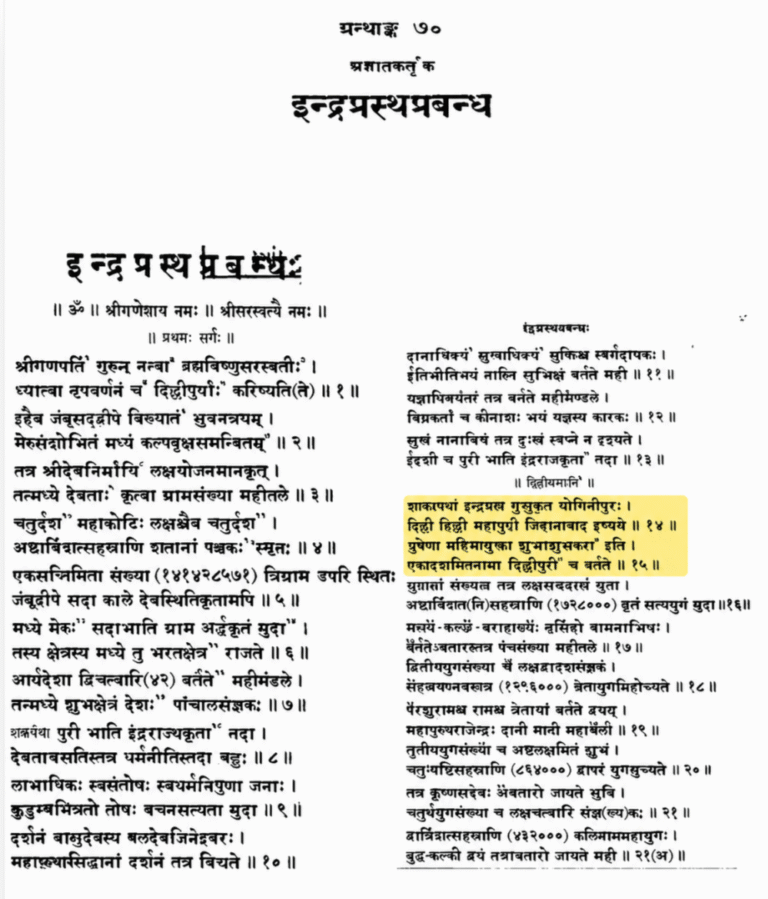
The eighteenth-century text, namely Indraprastha Prabandha first canto (PrathamSarga:Couplet14-15) gives the eleven names of Dilli (Delhi):
Sakrapantha Indraprastha Subhkrt Yoginiprah, Dilli Dhilli
Mahapurya Jihanabad Ishyate. Sushena Maimayukta
Shubhashubhakara Iti, Ekadashmitmana Dillipuri Vartate.
There are eleven names of Dilli: Shakrapantha, Indraprastha, Shubhakrita, Yoginipur, Dilli, Dhili, Mahapuri, Jihanabad, Susena, Mahimayukta, and Shubhashubhakara. The Prabandha provides an intriguing explanation for the naming of Dilli, which was etymologically known as Dhilli. It really reiterated the story of “Dilli Killi Katha” (legend), which was composed by Prithviraj Raso. A common misconception is that one name replaced another in a linear sequential process. There is a prevalent misperception that names were replaced in a linear line. The evidence indicates a far more nuanced reality. Within overlapping literary traditions, Indraprastha, Yoginīpura, Dhillikā, and Dhillī often coexisted. Because different cultures had distinct perspectives on the landscape, they used different names. Indraprastha was emphasized in the Sanskrit epic traditions; Yoginīpura was mentioned in Jain literature; Dhillikā was used in inscriptions; Dhillī/Dhillikā was chosen in narrative and legend traditions. Each name emphasized a different facet of a comparable broader region. There could be a contestation regarding which name originated first Yoginīpura or Dilli.
A chronological analysis of literary and epigraphic sources indicates that Yoginīpura was the earlier and prominent settlement, as it was located at a strategic locus of the Uttarāpatha; consequently, Yoginīpura initially emerged as a crucial temple commercial centre and over time, particularly during the reigns of the Tomara and subsequently the Chāhamāna dynasties. The settlement acquired administrative and political importance, eventually becoming Dhillī. This period is characterized by the transformation of the historical and spatial heritage of ancient Indraprastha into the early medieval urban structure that eventually evolved into Delhi. Thus, the transition from Indraprastha to Yoginīpura and subsequently to Dhillī signifies more than a mere change in place-names; it exemplifies a complex process of urban continuity, political transformation, and cultural reinterpretation across different historical periods.
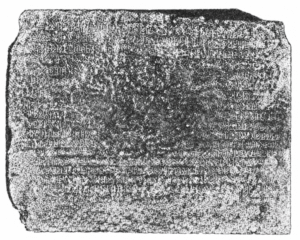
Delhi Museum Stone Inscription. Source : Puspa Prashad (Plate II)
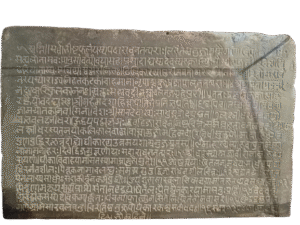
Sarban Inscription. Source: Purana Qila Museum
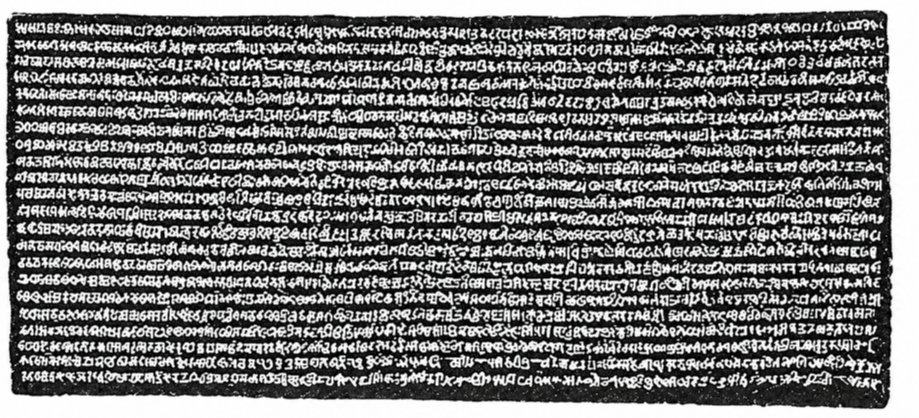
Palam Baoli Inscription. Source : Puspa Prashad (Plate I)
Labour Behind Sovereignty: Shalimar Bagh and the Emergence of Haiderpur Village
Ankush, PhD Scholar, Centre for Historical Studies, JNU (Published 16th June, 2026)
A couple of years after the formal inauguration of Shahjahanabad as the new capital of the Mughal Empire, Emperor Shah Jahan decided to build a Mughal-style garden in the adjoining countryside. The site chosen for the garden was situated approximately six miles from Shahjahanabad. Sayyid Ahmad Khan, in his Āsār us-Ṣanādīd, stated that “Shah Jahan himself named this pleasure garden Shalimar; in Hindi, the word shala means window and mar means pleasure and luxury.” Thus, the site of Shalimar Bagh, marked by notions of luxury and pleasure, came into existence. A few years later, the garden located in the countryside became intertwined with the exercise of sovereignty and emerged as a space of political significance. It would not be incorrect to describe the garden as Delhi’s first “coronation park.” After the long war of succession, Aurangzeb chose Shalimar as the venue for his coronation. The ceremony marking his accession to sovereignty took place within the precincts of the garden on 31 July 1658. Thereafter, the political importance of the garden remained largely uninterrupted. Invaders such as Nadir Shah and his successor in invasion, Ahmad Shah Abdali, encamped there with their armies. Later, the new sovereigns in the form of the British selected the site as a summer residence. However, the upheaval of the Revolt of 1857 severely damaged the garden’s fortunes, and its restoration was abandoned by successive regimes. The garden’s appearance in political narratives represents only one side of its history. Beneath this landscape of sovereignty and imperial leisure existed an equally significant world of labour.
To understand the making and maintenance of Shalimar Bagh, it is necessary to shift our attention from the sovereign and his seat of authority to the labouring population whose efforts sustained such spaces. As Shalimar was one of the major structure of the newly constructed city of Shahjahanabad, its construction and maintenance generated a continuous demand for labour. Such movements of labour, in turn, required spaces of habitation. Many workers initially settled in temporary encampments and informal habitations located close to their places of work. Over time, some of these settlements acquired a more permanent character. One such process can be traced through the emergence of the village of Haiderpur. Oral traditions and colonial records suggest that a significant section of the settlement’s inhabitants belonged to the Ahir community, who had migrated from the Rohtak region. During the initial phase of settlement, these migrants established a small habitation, locally known as a navāḍā, near the garden. The settlement functioned as a residential base for workers engaged in gardening, agriculture, and other forms of labour associated with the maintenance of the imperial landscape. Over successive generations, this habitation gradually transformed from a temporary settlement into a permanent village.
Initially, the settlement formed part of the larger village of Badli. As its population increased, Haiderpur gradually established a distinct identity separate from its parent settlement. To sustain everyday village life, members of various service and artisan castes were invited to settle there. Many of these groups not only served the inhabitants of Haiderpur but also provided services to the royal establishment associated with Shalimar Bagh. The Mali community, for instance, used Shalimar as their principal workplace while maintaining Haiderpur as their permanent place of residence. Their expertise in horticulture and agriculture was sufficiently renowned to attract the attention of contemporary travellers such as Jean de Thévenot. Describing the garden, Thévenot referred to it as a country house where “all sorts of trees and fruits grow, but among them the pineapples are exceedingly good.” A century later, Sayyid Ahmad Khan also remarked upon the gardening practices at Shalimar Bagh. He noted that “there were many different varieties of trees in the garden, of which a few mango trees remain that are not available anywhere else.” These observations also point towards the specialised knowledge and labour of the gardening communities who sustained the garden across generations.
The settlement’s quest for formal recognition culminated in the nineteenth century. According to the Land Settlement Report (1880), the inhabitants approached Mirza Haider Ali Baig, a Risaldar, seeking recognition of their hamlet as a separate village in the revenue and administrative records. Signs of an expanding habitation, however, had already been noticed much earlier by Jean de Thévenot during his visit to the garden. After several generations of residence, the inhabitants’ efforts proved successful, and the settlement was officially acknowledged as an independent village. In recognition of the assistance provided by the officer, the villagers are said to have adopted the name “Haiderpur.” An alternative tradition attributes the village’s nomenclature to Nawab Haider Quli Khan, an influential noble during the reign of Muhammad Shah. According to this account, Haider Quli Khan held the garden and its surrounding lands as a jagir, and the village derived its name from his association with the locality. Regardless of its precise origin, the name reflects the enduring relationship between local settlement, labouring communities, and structures of political authority.
After the empires had vanished, the former site of sovereignty and leisure gradually retained its association with the natural landscape partly in nomenclature. Much of its original form was erased in the course of urban expansion. However, the Sheesh Mahal (Crystal Palace), the building site of Aurangzeb’s coronation and later a summer residence of the British, remained as one of the few surviving remnants of the imperial garden. Meanwhile, the neighbouring village of Haiderpur was transformed into an urban residential conglomeration. Yet what endured through the passage of time was the close proximity between these two early modern sites, now embedded within the characteristically urban landscape of contemporary Delhi. Their continued coexistence serves as a reminder of the intertwined histories of sovereignty and labour. To conclude, while the physical symbols of sovereignty have largely disappeared, the settlement created by the labour that built and sustained that sovereignty continues to survive.
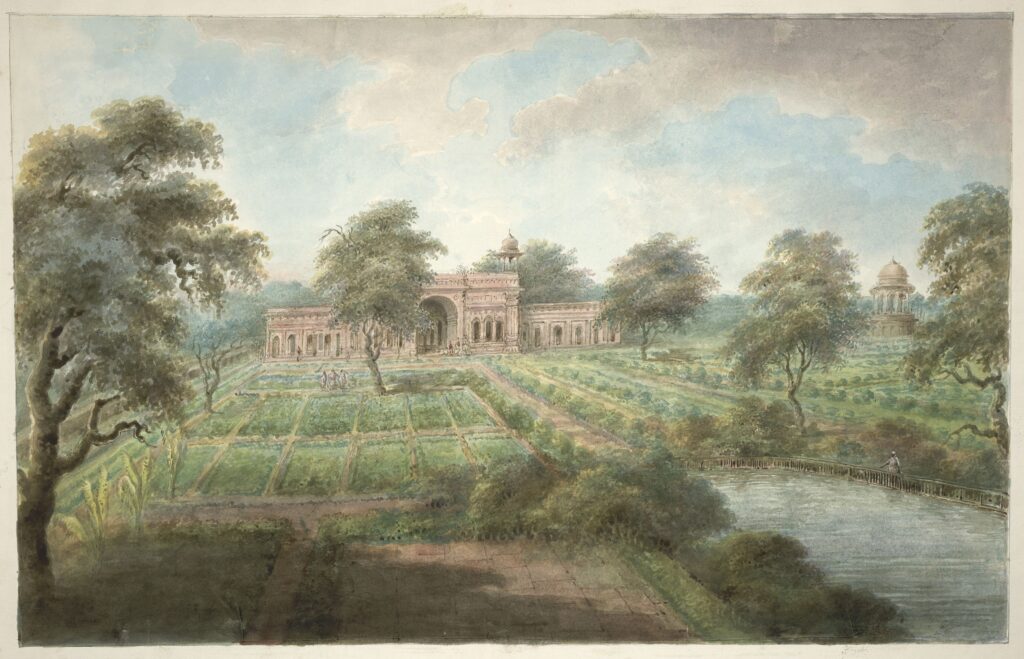
Image Credit: Shalimar Gardens, Delhi, 1814. Watercolour by Sita Ram. Courtesy of the British Library, accessed through Wikipedia.
Delhi beyond Emperors, Monuments and Colonial Architecture
Dr. Shekhar Tokas, Assistant Professor, Urban Studies, AUD
(From Personal Diary of Dr. Shekhar Tokas, 26 March 2011, Published on 23 March 2024)
Dominant historical narratives of Delhi have long been framed through the idea of successive imperial capitals, the “Seven Cities of Delhi” and the monumental legacies of Islamic and colonial rulers. The focus on dynastic power, monumental architecture, and imperial urban design has rendered invisible the people who cultivated Delhi’s land, the agrarian and pastoral communities who formed the city’s original social and ecological base.
This exclusion reflects the politics of historical knowledge production, the idea that history is never neutral but shaped by those who write it. Similarly, history is not merely about remembering the past, but about deciding whose past is remembered and how it is told. In Delhi’s case, the dominant narrative privileges the rulers who built palaces and forts, while silencing the communities who sustained those empires. The native inhabitants of Delhi, the cultivators, pastoralists, and village communities are largely absent from the story of the city’s making.
Yet Delhi’s rural landscape is well documented across centuries. Ibn Battuta’s 14th-century travel accounts during the Tughlaq dynasty describe a region surrounded by fertile villages, forests, and agricultural settlements that fed and supported the walled city. Two centuries later, the Ain-i-Akbari (16th century), compiled under Emperor Akbar, recorded Delhi’s sarkar and its numerous villages such as Palam, detailing land revenue, caste compositions, and patterns of cultivation. These accounts affirm that Delhi was not an empty imperial stage, but a densely inhabited agrarian landscape dominated by Jats, Gujars, and Chauhans.
Under British rule, administrative reports such as the Gazetteer of the Delhi District (1883–84) systematically documented around 350 villages, describing landholdings, crop patterns, and demographic structures. These sources demonstrate a continuity of rural habitation that predated and outlasted successive empires. However, when Delhi was declared the new capital of British India in 1911, the colonial state acquired land from nearly 150 villages under the 1894 Land Acquisition Act, displacing long-standing communities. The Viceroy’s House (now Rashtrapati Bhavan) itself stands on the lands of Raisina and Malcha villages, symbols of how imperial urbanism effaced the rural.
Post-Independence urban expansion continued this erasure. Partition refugees, development projects, and the state’s modernization agenda transformed farmlands into residential and institutional areas like Hauz Khas and R.K. Puram, all built on village lands of Hauz Khas and Munirka Village. The state’s maps redrew Delhi, but its memory of villages persisted through place names, kinship ties, and surviving lal dora settlements.
To foreground Delhi’s villages is to challenge the city’s elitist historiography and reclaim the agency of those who made and remade Delhi across centuries. Rewriting Delhi’s history from the perspective of its villages restores the voices of its first inhabitants and exposes how history has too often served the powerful rather than the people.
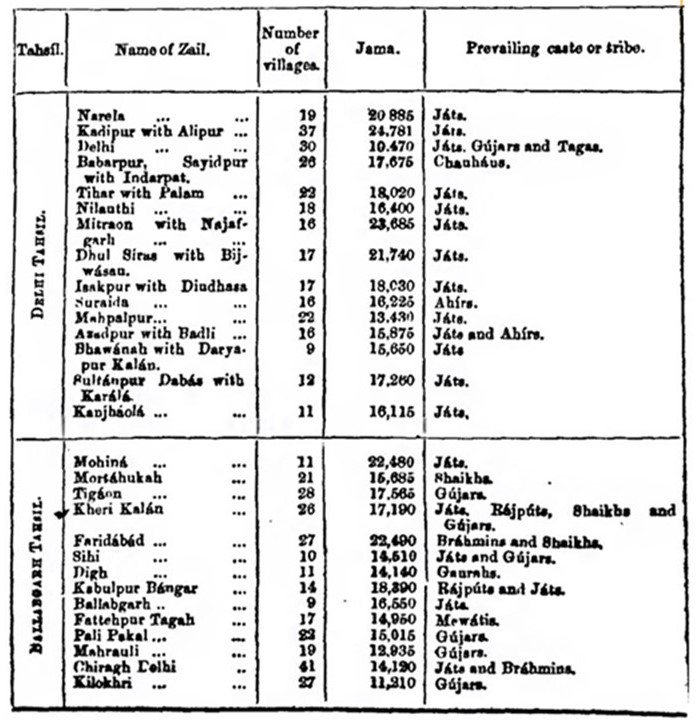
Zail-wise distribution of villages with dominant castes in Delhi (288 Villages) and Ballabgarh (41 Chirag Delhi, 19 Mehrauli) Tehsil. Source: Gazetteer of Delhi District (1883-84)
The Bull That Would Not Leave
Reading the Harappan Seal Motif in the Ahoi Mala of Delhi’s Agro-Pastoral Communities (Published 13th June 2026)
Shalaish Baisla, School of Heritage Research & Management, AUD
In the material culture of any region, certain forms outlive the meanings that produced them. They survive not because each generation understands them, but because they are bound to acts “a fast, a marriage, a harvest” repeated without interruption. The form becomes a vessel; the contents are quietly replaced. One such form, I want to suggest, is the bovine motif of the Harappan stamp seal — and it survives in a living ritual object worn today in the agro-pastoral villages absorbed into modern Delhi: the silver Ahoi mala.
The claim is narrow. Not that the mala descends by an unbroken line from a Bronze Age workshop, but that the two objects share a compositional grammar so specific, and emerge from communities occupying so nearly the same landscape, that the resemblance deserves to be treated as a problem in cultural continuity rather than dismissed as coincidence.
Delhi lies within the eastern reach of the Harappan world. Alamgirpur, the easternmost confirmed settlement, sits barely twenty-eight kilometres away on the Hindon. The communities most associated with the Ahoi mala — Ahir and Yadav cattle-keepers, Gujjar pastoralists, Jat agriculturists of the Yamuna–Aravalli belt — are the descendants of that long pastoral occupation. Their central anxieties have stayed remarkably stable: the survival of the herd, the survival of sons, the continuity of the line.
Consider the seal. The most frequent figure in the entire Harappan corpus is the animal we call the “unicorn” — a label that is an artefact of perspective. Rendered in strict profile, a two-horned animal shows one horn; Cunningham, in the 1870s, called it plainly a “bull without a hump.” The composition is fixed across cities: a single male animal in profile, before an upright cult object, beneath a short line of script.
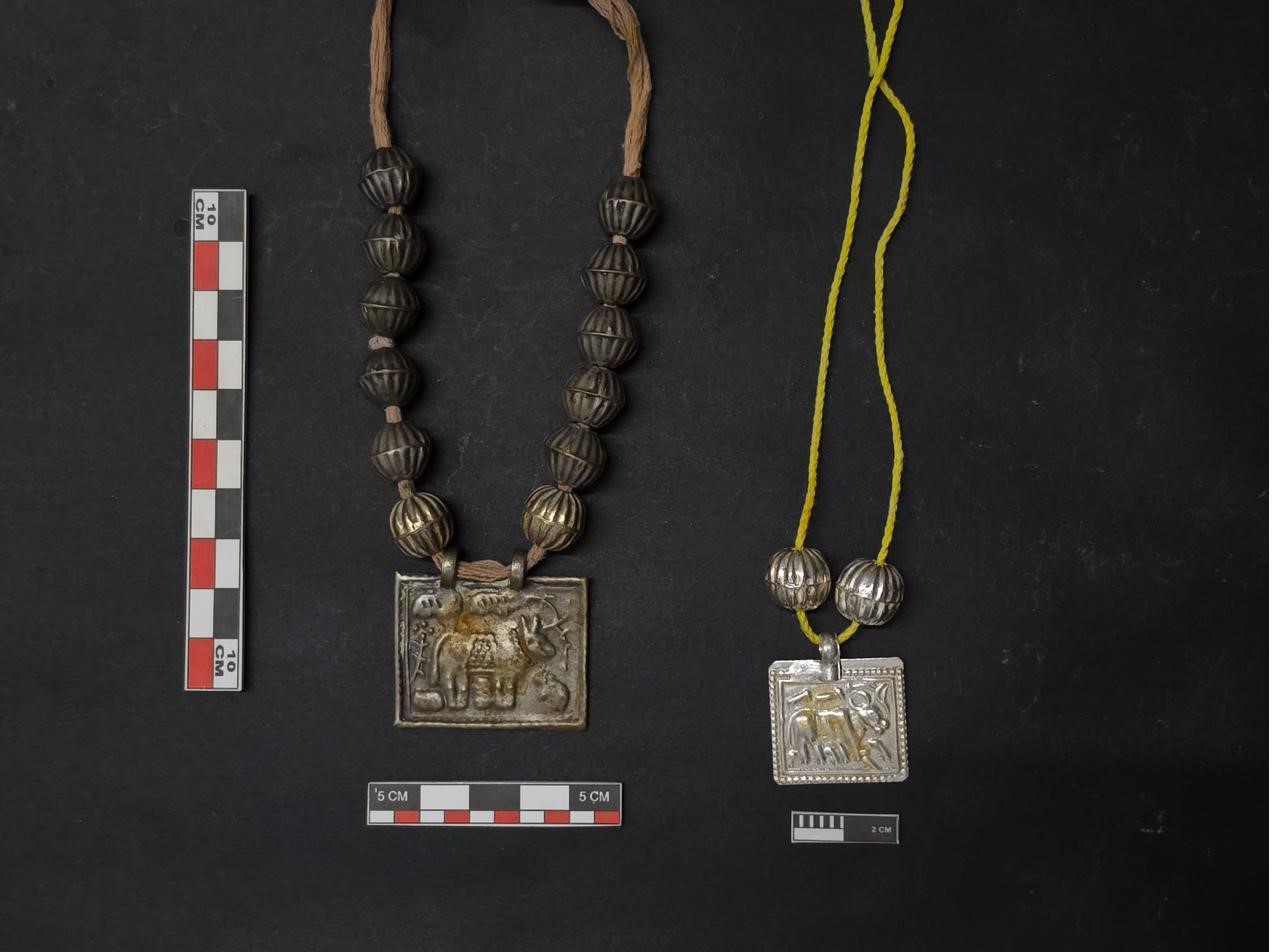
Now consider the locket of the Ahoi mala. It is a small rectangular plaque. At its centre stands a bovine in profile. Below the head sits a raised ritual object; along the upper edge runs a band of embossed marks; the plaque hangs between two heavy ribbed beads. Set the two side by side, and the correspondence is not thematic but structural — the same field, the same posture, the same subordinate object, the same upper register.
The most instructive evidence is what happens over time. Place an older mala beside a newer one, and you see attrition: thick, ribbed beads on a cotton cord and a deeply struck plaque give way to a lighter, smaller plaque, flattened nearly to a stamp, strung on synthetic thread. The execution coarsens; the iconography thins. And yet the bovine remains. Most women who wear the newer locket know only the porcupine recension and could not say why an animal stands at its centre. It survives because the form is the carrier of the memory, independent of any understanding of it. The meaning has changed completely. The image has refused to move.
None of this is proof of descent, and it is not offered as such. But the question is real, and we have not been in the habit of looking at it this way. The similarities are striking.
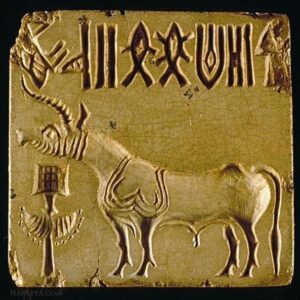
Plate 1. Mature Harappan stamp seal: a bovine in strict profile before a cult object, beneath a register of script signs (c. 2600–1900 BCE).
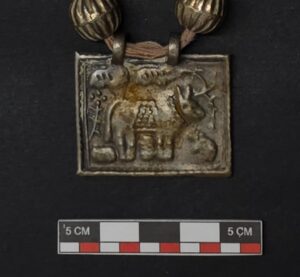
Plate 2. Silver Ahoi mala locket: a standing bovine in profile, a ritual object set low before it, embossed marks along the upper edge — the same compositional grammar, rendered in silver.
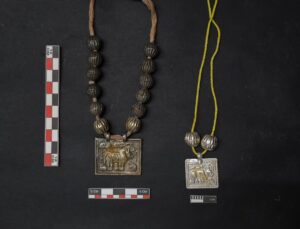
Plate 3. Two generations of the Ahoi mala. Left: the older example — heavy ribbed beads on cotton cord, a dense, deeply struck plaque. Right: the newer — a smaller, simplified plaque on synthetic thread. The bovine motif persists through every reduction.

Plate 4. Ribbed silver beads of the Ahoi mala. Families add a bead for each child’s birth, making the ornament a living record of the line it is meant to protect.
Culture from Below: Delhi Dehat & Mass Cultural Practices
Ankush, PhD Scholar, Centre for Historical Studies, JNU (Published 12th June, 2026)
For a long time, the space of Delhi was dominated by powerful rulers belonging to various kingdoms and dynasties. To advance their agenda and consolidate their hegemony over their subjects, rulers employed a range of strategies. Among these, culture played a significant role in controlling the subjects’ minds and fostering greater empathy towards the ruling regimes. To ensure loyalty and empathy towards the ruling regime, the state, at various levels, opened its treasury for cultural performers. Many performers and artists were inducted into state service. Alongside these established patterns of cultural patronage, there existed communities located in the rural hinterlands surrounding the city whose cultural practices were more aptly characterized as forms of ‘mass culture’. Generally, placed within the binary category of non-elites, their cultural forms survived for a long time ‘without patronage’. Their self-consciousness towards inventing and developing cultural practices could have been a major factor in the growth of such traditions.
There is no fixed date for the origin of cultural practices in the dehat region of Delhi. However, we can reasonably assume that these cultural forms predated the medieval states of the Sultanate and the Mughals. More pertinently, these cultural forms can be understood as the outcome of a continuous dialogue between people and their cultural practices. Over time, the population inhabiting the dehat of Delhi gradually developed into a relatively homogeneous social milieu, where different castes and religious communities ensured a shared human presence. There was no fixed pattern observed by rural cultural practitioners regarding the practices to be performed. At the same time, these communities remained open to the diffusion of cultural forms from the outside world, particularly the urban sphere, a pattern also observed in medieval Europe. George Duby identified a reverse trend in which cultural traditions diffused from the lower strata of society to elite culture. In Delhi, such a trend cannot be clearly established, but the possibility of shared cultural practices between different groups remained open.
Furthermore, the language or dialect spoken in the dehat largely escaped the growing influence of state-oriented languages such as Persian and Urdu. This inference can be supported by the negligible impact of Urdu, whose expansion did not significantly extend into the villages of Delhi Dehat, despite their close proximity to the city. The dehat of Delhi, however, acquainted itself with wider practices through various forms of cultural observances. Fairs and festivals were organised around themes of hero worship, ritual bathing, offerings, worship, and entertainment. These practices often transcended individual villages, bringing together communities from across the region, and the annual calendar was marked by the regular observance of such events. To understand these cultural forms and practices, we primarily rely on two types of sources: oral traditions and colonial gazetteers. Historical mapping was a major feature of the former, although the knowledge it provides is less verifiable for the contemporary world. Colonial gazetteers, on the other hand, did not devote much attention to tracing the historical origins of cultural practices. Instead, they recorded details such as the annual number of fairs and festivals (34), their sites, themes, duration, and footfall.
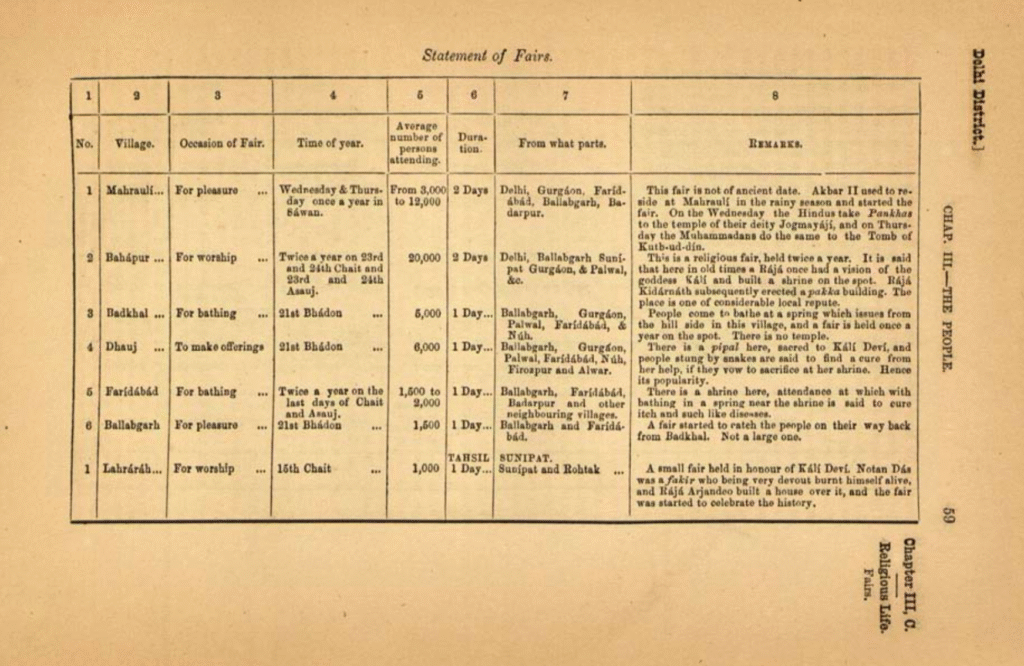
List of Fairs in Delhi District, 1883–84. Source: Gazetteer of the Delhi District.
Cannot Let Bygones Be Bygones: Memory, Grief & Nostalgia of Delhi’s Decapitated Villages
Pavi Beniwal, PhD Scholar, Urban Studies, AUD (Published 11th June, 2026)
“A people without the knowledge of their past history, origin and culture is like a tree without roots” – Marcus Garvey (1923)
I come from Pitampura village, previously known as Pithopra village. The village was established in 1430 when two brothers, named Prithvi Singh and Chauhar Singh, settled in the area. Being a native of Delhi, I have never really seen the so-called village life. I have seen my village through the mnemonic narratives of my grandfather and father. They describe a village that is not made up of dense housing or narrow lanes, but a village with large acres of land, ponds, wells and cattle.
As I reflect on my village, I realise how my memory of the village is constituted through the stories I have heard from my family. However, it is deeply disheartening not to find the history of Delhi’s villages documented in any official source. Why is it that the history of the natives is erased and made officially almost invisible? Why, despite being a native, have I always struggled to find my sense of belonging in the city? Why did I believe in the mainstream idea – “dilli sabki hai”? But, doesn’t the history of our villages tell a different story?
Then again, no one remembers. And, more honestly, no one was ‘allowed’ to remember! This is what Zerubavel (1997) calls mnemonic decapitation : the deliberate official invisibilisation of certain histories to propagate a particular, more convenient history. The histories of natives are erased because no one wants to officially acknowledge the painful process of land acquisition. Moreover, Delhi, being the hub of political power, it is always convenient to have no indigenous population, which has a strong hold over the land of the state. Had it not been for oral narratives, the natives themselves would have forgotten about their histories. And many actually have!
This is what happened to Delhi’s villages. Their land was taken with minimal compensation, still pending in some villages to this day. Their livelihoods were dismantled, the villages were left out of urban development, and their histories were never officially acknowledged, leaving a strong void and sense of uprootedness within the community. Moreover, the community was made to shrink and confined to small pieces of land, after taking away acres of their land. I must clarify, I am not against land acquisition. Development rarely happens without some kind of displacement. However, I strongly believe that development without upholding dignity is dispossession. The process could have been made humane through some skill and vocational training, by helping natives establish some livelihood and most essentially, by acknowledging their histories honestly and officially.
No matter what I write, my heart will always ache for the land lost. Closely attached to my grandfather, I will always grieve that I cannot walk barefoot on the same land that he toiled. My eyes will always get teary knowing that I can no longer stand in the air that once smelled like my grandfather, or that I could never hold the sand that carries traces of his sweat. The only tangible thing that connects me to my grandfather is a small piece of land left in the urban village today. His last words to me were:
“bhaut kamaya jhijhi, niri khubaat kari par ke kare saari zameen nuye chali gyi” which roughly translates to “Earned so much, worked so hard, but what to do…all the land just slipped away”.
These words still echo in my mind. Losing land is not a loss and grief that remains limited to one generation; it percolates further to the next generations. Somehow, I will always carry the void of a life I never got to live.
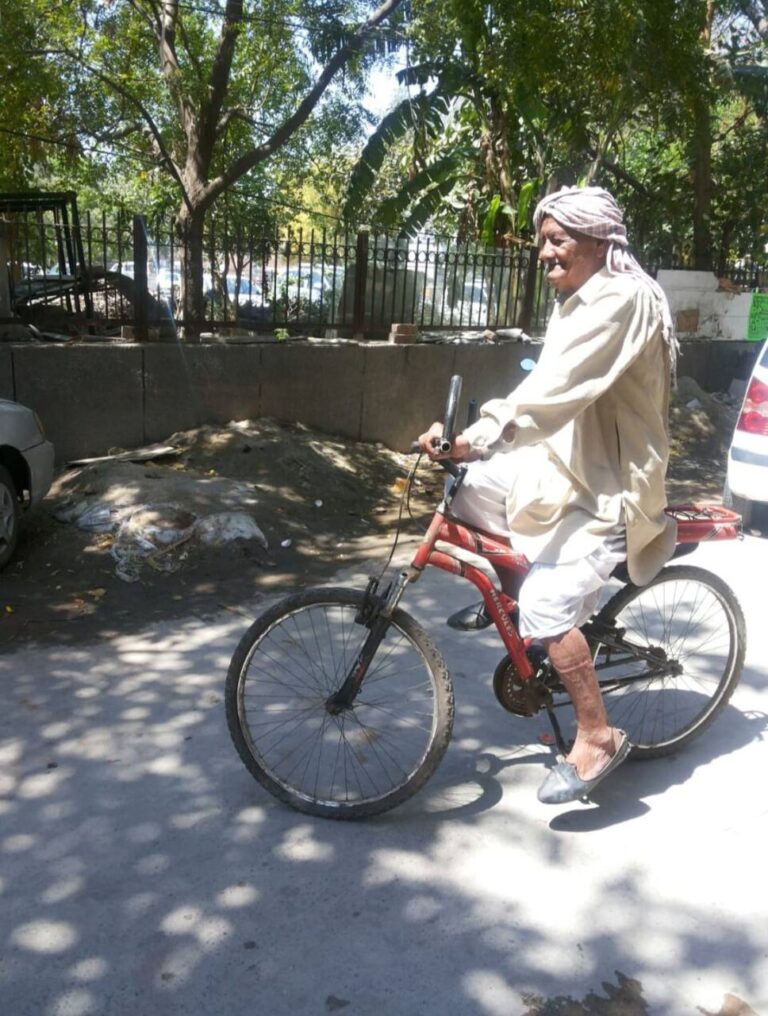
Ch. Puran Singh Beniwal cycling in Pithopra village (2015)
Sign Up For More Update

